Plan your entire R2I move in Breather
Model your 401k strategy, Social Security timeline, and India expense plan — all in one place.
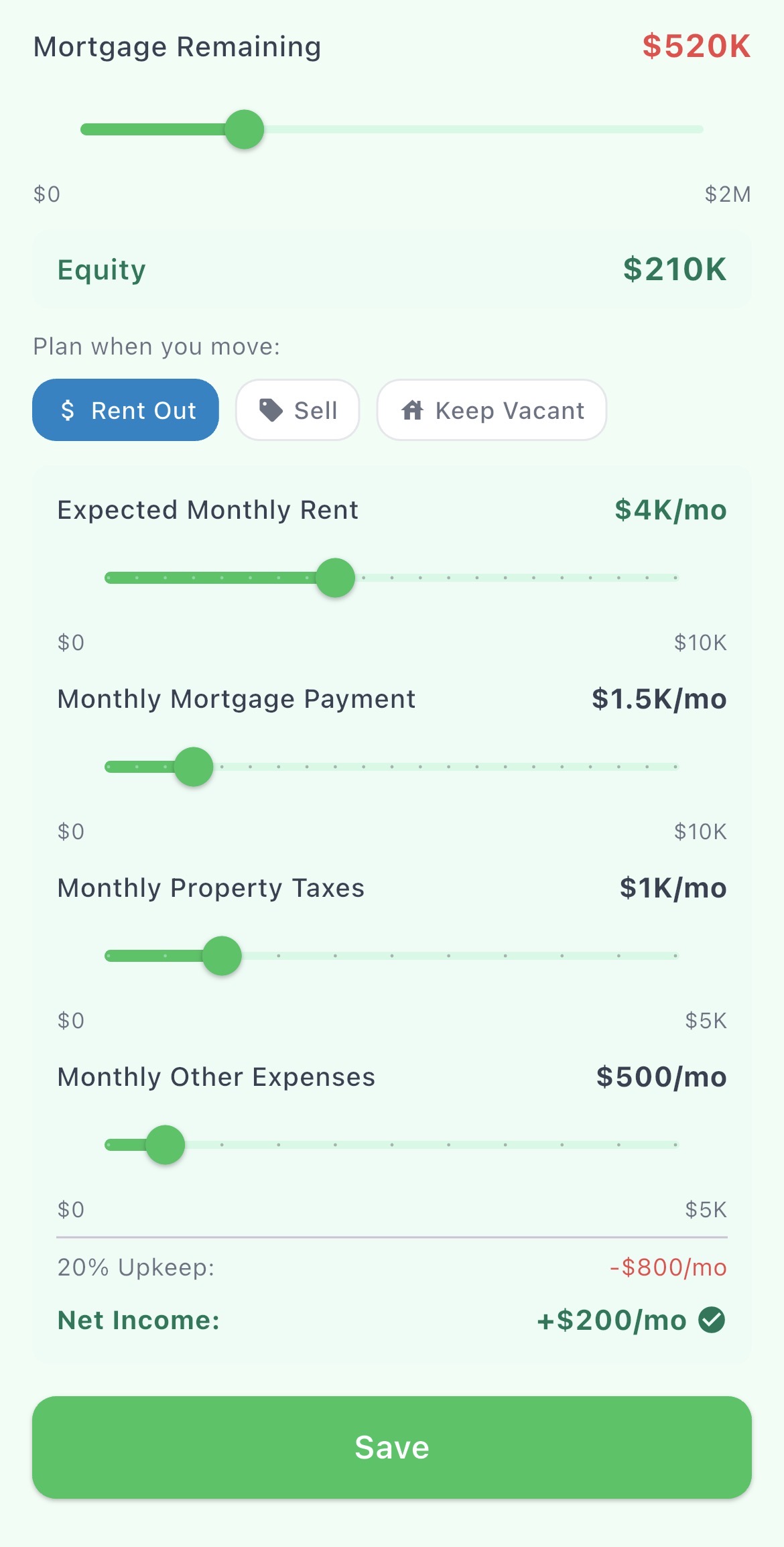
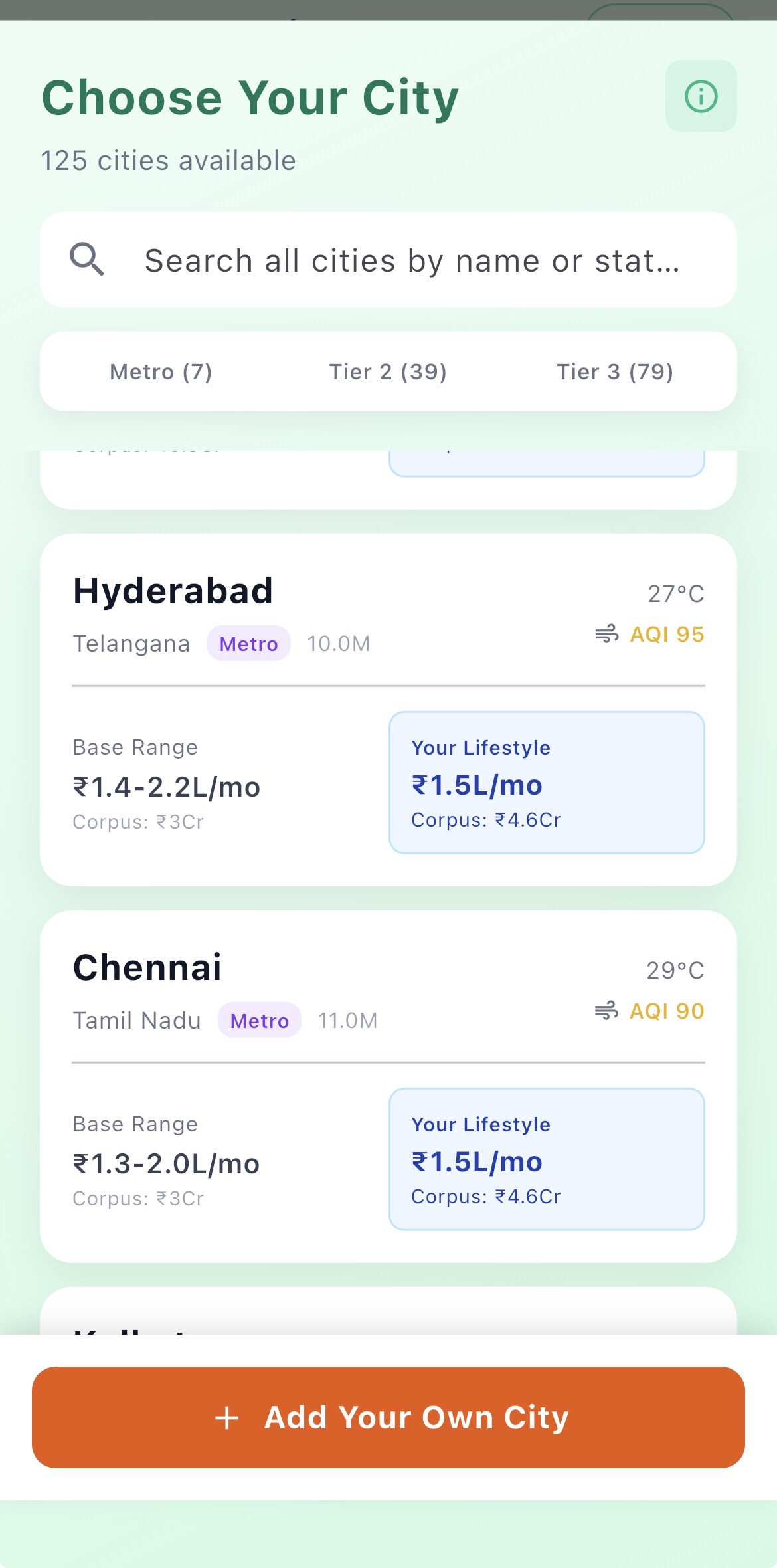
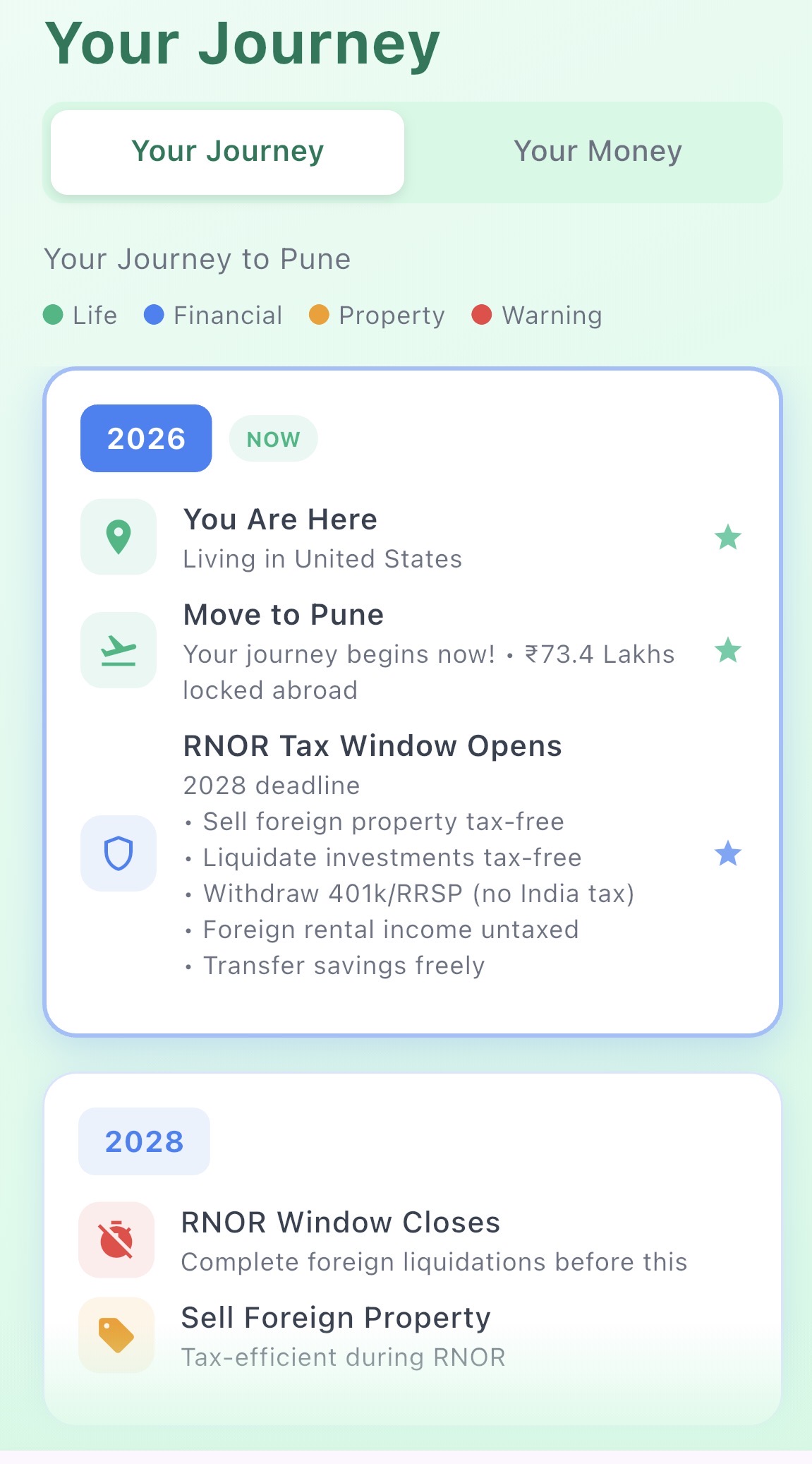
The logistics of the move are the easy part. The financial decisions you make in the 12 months before you leave — 401k, Social Security, bank accounts, taxes — determine whether your return succeeds long-term. Here's what you actually need to know.
Many NRIs who move back in their 40s don't call it retirement. They're planning to do some consulting, pick up a remote contract, or run a small business in India. That framing is fine — but the financial planning is identical whether you plan to earn anything or not.
Why? Because the core question is the same: does your corpus, combined with any future income, cover your expenses for the rest of your life? Whether you earn ₹0 in India or ₹1L/month from occasional work, you need to model the math. Income from consulting might change the numbers, but it doesn't change the framework.
The place to start is the Retire in India Calculator — enter your corpus, your expected monthly spend, and your age, and you'll see a 20-year projection in minutes. If consulting income is part of your plan, model it first without it. That's your safety baseline.
If you're planning a full retirement with no further work income, the Retiring in India From the USA guide covers the retirement-specific financial and lifestyle planning in depth. But if you're still figuring out whether you're ready to make the jump at all, keep reading — this checklist is for you.
Most long-tenure US tech and finance professionals have the majority of their net worth locked in a 401k. Before you book that one-way ticket, you need a clear strategy for this money. There are three options, and none of them is universally right.
If you're 50 or older, this is almost always the best path. Leave the 401k untouched, let it keep compounding, and access it penalty-free from age 59½. You'll still owe income tax on withdrawals, but you avoid the brutal 10% early withdrawal penalty. A $600K 401k at 50 becomes roughly $1.1M by 59½ at 7% growth — that's a massive difference.
The 10% federal penalty plus income tax on the withdrawal amount can cost you 30–40% of the balance. That's not a typo. A $500K early withdrawal in a 25% tax bracket with a 10% penalty leaves you with approximately $325K — you've lost $175K to the US government before a rupee ever reaches India.
A Roth conversion means paying taxes now on your traditional 401k balance, then letting the money grow tax-free and withdrawing it tax-free later. This makes sense if you expect to be in a higher tax bracket in the future, or if you want to leave a tax-efficient inheritance. The complexity: you need to have after-tax dollars to pay the tax bill on conversion — it doesn't make sense if you'd have to sell assets to pay the tax.
The key insight at ₹87/USD: a $500K 401k is ₹4.35 crore before any taxes or penalties. After a 35% effective rate on early withdrawal, you're left with ~₹2.8 crore. That ₹1.55 crore difference will change your retirement math in India materially. For a complete strategy guide, see Return to India Financial Planning: Complete NRI Guide.
This is the most overlooked part of the NRI financial picture. US Social Security is fully payable to residents of India. You don't need to live in the US to collect it.
If you've worked in the US for 10+ years (earned 40 credits), you're eligible for Social Security benefits. Full retirement age is 67 for most people born after 1960. You can take a reduced benefit starting at 62. The average Social Security benefit as of 2026 is approximately $1,700/month. At ₹87/USD, that's ₹1.48 lakh/month — landing in your Indian bank account every single month for the rest of your life.
Think about what ₹1.48L/month means in India. That's more than most comfortable retirees in Tier 2 cities spend on everything combined. It completely covers rent, groceries, utilities, and domestic help in most of the country — and it grows with US cost-of-living adjustments each year.
One more critical point: the India-US Social Security Totalization Agreement. If you've worked in both India (under EPFO) and the US, you can combine your work credits from both countries to qualify for benefits you might not reach with US credits alone. This matters if you had 8 years in the US — not enough for full eligibility on its own, but potentially enough when combined with Indian work history.
Check your statement at ssa.gov/myaccount before you leave. It takes 10 minutes and gives you your projected benefit at age 62, 67, and 70.
The financial admin around an international move is unglamorous but genuinely important. Getting this wrong means compliance headaches, frozen accounts, or lost tax benefits.
Do not close your US bank account before leaving. You need it for Social Security payments (which arrive via direct deposit), any remaining US income, ease of transactions when you travel back, and as a financial backup if something goes sideways in India. Update your address to a trusted family member in the US or use a mail-forwarding service. Most US banks can maintain your account as a non-resident as long as you disclose the status change.
You need both. NRE (Non-Resident External) is for money you're bringing from abroad — it's fully repatriable and the interest is tax-free in India. NRO (Non-Resident Ordinary) is for income you earn in India (rental, dividends). Repatriation from NRO is limited to $1M/year and Indian tax applies. You can open both before you leave — several Indian banks offer this process online for US residents.
FBAR (Foreign Bank Account Report, FinCEN Form 114) is required for any US person with more than $10,000 in aggregate in foreign financial accounts at any point during the year. Once you have Indian bank accounts, this is you. Filing deadline is April 15, with an automatic extension to October 15. The penalties for willful non-compliance are severe — up to $100K or 50% of the account balance per violation.
Most US brokerages restrict or close accounts when the account holder becomes a non-US resident. This is a critical issue. Sort this out before you leave. Schwab International is the most commonly cited exception — they maintain accounts for non-US residents. Interactive Brokers is another option. If you have a standard Fidelity, Vanguard, or Schwab domestic account, call them and ask directly about their non-resident policy.
People obsess over corpus and monthly spend but forget to budget the move itself. A cross-continental relocation with a family is a six-figure rupee event. Here's what to realistically plan for:
This is money that needs to be liquid well before the move date — don't plan to fund it from selling assets at the last minute. And don't forget it in your retirement corpus calculation. If you withdraw ₹15 lakh from corpus to fund the move, your projection starts from a lower base. For ongoing cost comparisons between the US and India post-move, the Cost of Living: India vs USA guide breaks down expenses category by category.
There's no perfect moment to move. But there are clear signals that tell you the financial foundation is solid enough to go. Here are the three that matter most:
The 4% rule — widely validated in retirement research — says you can safely withdraw 4% of your portfolio annually and have it last 30+ years. That means you need 25× your annual India expenses in corpus. If your India lifestyle costs ₹2L/month (₹24L/year), you need ₹6 crore. If it costs ₹1.5L/month (₹18L/year), you need ₹4.5 crore. Run your exact number with the Retire in India Calculator — it applies Indian inflation assumptions, not US ones.
Your first year in India is financially chaotic. You're settling in, making large one-time purchases, discovering your real expense level, and potentially waiting for investments to be set up properly. Have at least 12 months of your planned India budget in cash or a liquid instrument — not locked in 401k, not in equity that can drop 30% the month you land. This buffer protects you from making bad financial decisions under stress.
Most NRIs underestimate Indian inflation because they haven't lived there recently. General inflation runs 6–7%, but healthcare inflation is 10–12% and private school fees tend to increase 8–12% per year. Before you declare yourself ready, run the scenario with inflation at 7% for 20 years and see what the corpus looks like. If it's still comfortable, you're genuinely ready.
Use the Retire in India Calculator to check all three signals against your actual numbers. Also consider reading How Much Money Do You Need to Retire in India — it gives a comprehensive breakdown of what's needed at different ages and cities, and will help you calibrate whether your corpus is in the right range. For city-specific cost planning, Best Cities to Retire in India compares costs and lifestyle across the major options.
If you're planning a phased approach — maybe spending time in both countries for a few years before fully committing — also consider reading Is ₹10 Crore Enough to Retire in India to understand what a larger corpus unlocks in terms of lifestyle optionality.
Model your 401k strategy, Social Security timeline, and India expense plan — all in one place.
Run your full R2I financial scenario in Breather — corpus, 401k strategy, Social Security, India expenses — and see if the math works.